WPCA extends sewer hookup moratorium six months
The Water Pollution Control Authority voted to extend East Hampton's sewer connection moratorium six months, citing unresolved nitrogen-removal limits at the treatment plant.
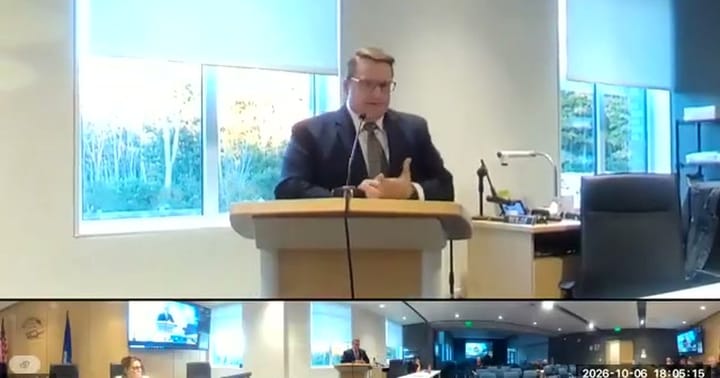
Water Pollution Control · Meeting of October 13, 2026
EAST HAMPTON — The Water Pollution Control Authority voted to extend East Hampton's sewer connection moratorium six months, citing unresolved nitrogen-removal limits at the treatment plant. Acting Public Utilities Administrator Scott Clayton said the town spends "$30,000 or $40,000" a year buying nitrogen credits because the plant, upgraded decades ago to hit six milligrams per liter, has never dropped below eight or nine. The board also directed its representatives to Joint Facilities, the regional operator shared with Colchester, Hebron and Marlborough, to keep East Hampton's sewer maintenance work in-house rather than splitting it among towns; Clayton said each town pays roughly $150,000 a year for that service.
On a proposed water system at 30 Long Crossing Road, where resident Leonard Johnson said one home went without running water for two and a half years, member Ted Hintz Jr. argued against pre-committing to town ownership: "Why would we take it over and let them maintain their own until such time?" The board took no vote on that question, deferring to a pending Planning and Zoning Commission review.
In the full story:
- Who Was There
- Organizations And Documents Referenced
- The complete report — 2,423 words
Source: the Water Pollution Control meeting of October 13, 2026, reported from the official video recording and transcript.
The Full Article
Procedural Opening
The meeting opened with the pledge of allegiance and a brief procedural vote to adopt "the limits as amended," apparently correcting a document that had erroneously referred to "Chairman Solomon" in a context requiring updating. The board approved the amended version by voice vote with no recorded opposition. The item consumed under two minutes and carried no substantive policy content.
Public Comment: Long Crossing Road Water Problems
Background and stakes: A private party has proposed building a water system at 30 Long Crossing Road, a parcel within the town's water Exclusive Service Area (ESA), the zone where East Hampton's water utility has the right and eventual obligation to serve customers. The proposal arrives against a backdrop of documented water-supply failures in the immediate neighborhood.
The question before the body: whether, and under what conditions, the WPCA should indicate willingness to eventually take ownership of a water system built at that address.
Substantive content: Leonard Johnson, who said he lives at 21 Long Crossing Road, told the board that water problems exist at multiple addresses nearby, including Alden's Crossing Road numbers one and three and Long Crossing Road numbers nine and 15. He said the house at 30 Long Crossing Road itself had no running water for two and a half years, during which two elderly residents drove to the Salmon River to fill water jugs by hand. Johnson argued that if a system is built, "the design must follow the best practices" and "the execution must be monitored daily by a qualified third-party water system engineer," because "the town eventually inherits the system for better or for worse." He also asked directly who would bear the cost of correcting any problems: "Who pays for it? ... The rate payers or the taxpayers?" The board did not answer that question during public comment; it closed the comment period and moved to the agenda.
The deliberation: The question resurfaced later in the meeting under the water-system agenda item (addressed below), where board members wrestled with the same cost and ownership issues Johnson raised.
Procedural steps and outcome: No board response or vote occurred during the public-comment period itself, consistent with normal practice of reserving public comment from immediate board action.
Joint Facilities Committee Update
Background and stakes: East Hampton's wastewater collection system maintenance is performed under an interlocal arrangement with Joint Facilities, a regional operating entity serving East Hampton, Colchester, Hebron and Marlborough. Internal conversations within Joint Facilities about restructuring staffing and operations prompted the WPCA to weigh in on how it wants its own system serviced going forward.
The question before the body: whether to formally express a preference that East Hampton's collection-system maintenance continue to be performed by Joint Facilities personnel, rather than be split off to individual towns.
Substantive content: Scott Clayton, introduced by Chair Jack Solomon as the town's former public utilities superintendent, brought back from retirement to serve as acting public utilities administrator while that role remains vacant following a staffing gap, walked the board through the financial logic behind the shared-services model. He said East Hampton and Colchester each pay Joint Facilities roughly $150,000 a year, a figure he said could rise to about $155,000, to cover collection-system maintenance, after-hours calls and specialized equipment such as jet trucks and cranes. Clayton said hiring two dedicated staff per town, the minimum needed to handle after-hours calls year-round, would cost more than that fee once wages, benefits and equipment are factored in. Hebron and Marlborough, which joined the arrangement later, pay differently: Clayton said Hebron is billed for about 65 hours of staff time a month at a blended hourly rate, amounting to roughly $10,000 a month, covering specific tasks like pump-station checks and grinder-pump repairs, while Marlborough has begun hiring outside contractors for some work instead.
A board member, not identified by name in the available recording, pressed Clayton to confirm that Joint Facilities remains adequately staffed to continue the external work East Hampton relies on. Clayton acknowledged the operation is currently short-handed, running five operators where it once had seven, which strains the crew whenever a confined-space entry, requiring three workers, pulls staff away from plant operations.
"But I mean, from this WPCA's point of view, we don't want you to be shorthanded," the member said, to which Clayton replied, "I can understand that."
Chair Solomon then asked the board to state its collective position for Joint Facilities' board to carry forward. "I'm trying to express this body's interest in having East Hampton's collection system maintenance done by joint facilities," Solomon said, adding that he wanted the board on record opposing any move toward decentralizing the work among member towns.
Procedural steps and outcome: A member moved to direct the WPCA's representatives to Joint Facilities to advocate for continuing East Hampton's maintenance arrangement as-is. The motion was seconded and approved by voice vote with members responding "aye" and no recorded opposition.
Implications and what is next: The vote signals the WPCA's preference heading into ongoing Joint Facilities governance discussions, though the authority acknowledged it cannot bind Colchester, Hebron or Marlborough to the same arrangement if those towns choose otherwise.
Sewer Operations Update
The board received a routine operations report: a new pump was installed at Laurel Ridge pump station number one; pump station number two had a face plate and gasket replaced after a swirling issue; crews provided traffic control for Prime Electric work, replaced manhole and water covers in the town center, and repaired the drive on East High pump number one. A broken frame and cover at Hampton Woods will be repaired even though the road there has not yet been formally accepted by the town, because the sewer line itself is already town property. Staff also noted sewer bills had gone out. No concerns were raised and no action was required.
Water Operations Update
Staff reported that the state-required water-system asset report, cataloging the town's wells, pumps and related infrastructure, was updated and filed with the state, a task now done every few years rather than strictly annually. No further water-side updates were presented at this point in the meeting; the board noted that additional water matters would be taken up later under the Long Crossing Road item.
Budget Status
The board reviewed year-end fiscal 2026 financial statements alongside early fiscal 2027 year-to-date figures. Staff cautioned that fiscal 2027 numbers currently show as "100 percent expended" only because that year's budget figures have not yet been entered following the fiscal year rollover. On the fiscal 2026 side, a transfer to capital on the water side remains outstanding and will be completed as part of final year-end closeout. Staff noted the sewer side is positioned to add funds to reserves, which the board can later decide how to reallocate, while acknowledging only a small contribution to capital was made in the current year. No board member raised concerns about the figures presented, and no vote was required.
Sewer Moratorium Extension
Background and stakes: The WPCA has maintained a moratorium on new sewer hookups tied to concerns that the wastewater treatment plant cannot reliably verify its true processing capacity, particularly for nitrogen removal. The moratorium requires periodic renewal by the board.
The question before the body: whether to extend the moratorium for another six months while the facilities plan proceeds.
Substantive content: A board member explained that when the plant's nitrogen-removal system was installed more than 20 years ago, one of the plant's major tanks was repurposed for nitrogen treatment, which the member said reduced activated-sludge processing capacity "by a third." Clayton confirmed the plant was designed to reach six milligrams of nitrogen per liter but has only ever achieved eight to nine milligrams per liter, even after engineering firm adjustments following the original upgrade. As a result, he said, the town buys nitrogen discharge credits annually "to the tune of $30,000 or $40,000," which he characterized as cheaper than funding a multimillion-dollar plant upgrade out of pocket. Clayton said the current facilities-plan study, conducted by the engineering firm identified in discussion as Tighe & Bond and required by the state every 20 years, should determine what upgrades are needed and whether state or federal funding might offset the cost.
The deliberation centered on whether adding sewer capacity before that study concludes would be prudent. One member said: "There's no point in adding a ton of demand and continue to keep buying nitrogen credits when we don't know what our true capacity is going to be." No member spoke against extending the moratorium.
Procedural steps and outcome: A member moved to extend the moratorium six months; the motion was seconded, discussed, and approved by voice vote with no recorded opposition.
Implications and what is next: The extension means no new sewer connections will be approved in East Hampton for approximately six months, pending results of the Tighe & Bond facilities study that will determine the plant's real capacity and any required nitrogen-removal upgrades.
Proposed Water System at 30 Long Crossing Road
Background and stakes: The town's water ESA covers all of East Hampton except areas served by Connecticut Water near Spice Hill, Mountain View and Lakewood. State statute and town code require any privately built water system exceeding 25 customers to eventually be transferred to town ownership. A property owner has indicated willingness to have the WPCA take over a system proposed for 30 Long Crossing Road, but the underlying land-use change needed to build it has not yet been approved by the Planning and Zoning Commission.
The question before the body: whether the WPCA should proactively confirm, in advance of land-use approval, that it will accept ownership of the system if built.
Substantive content: Staff said the developer's pro forma suggested a system serving as few as six customers, while another description characterized the site as a seven-lot commercial subdivision; board members did not reconcile the discrepancy. Members noted that under current zoning, the parcel could theoretically support up to 63 apartment units. Staff explained that any well serving multiple customers must satisfy state Department of Public Health requirements and demonstrate the well's "sphere of influence" on surrounding groundwater, with higher-capacity wells, for example those drawing 100 gallons a minute versus 10, facing more scrutiny. Staff added that the town would likely require a third-party engineer, paid for by the developer, to review any system design against town and state standards, with terms spelled out in a developer's agreement covering escrow, inspection and cost responsibility.
Member Ted Hintz Jr. argued against pre-approval: "If it's going to be six units, and it's going to be a private well, why would we take it over and let them maintain their own until such time?" He noted a system below the 25-customer threshold does not meet the legal definition of a "community water system," so no obligation to accept it exists yet. Another member, who disclosed living in the neighborhood and confirmed experiencing water issues personally, tied the discussion back to Johnson's public comment, noting the town has intervened before, citing Spice Hill, where the town supplied water via the high school's wells, and an instance in which a private water-delivery company had to truck water to a different development. Staff cautioned that any new well testing must not be "short-circuited" given its potential impact on neighboring properties' groundwater.
Members reached a working consensus, summarized by one participant: if the project becomes a qualifying community water system under state law, the town will not relinquish the ESA and will accept it; if it does not reach that threshold, the town will not take over private ownership. Staff agreed to research whether abutting property owners have any formal role in the well-certification process, since that information was not available during the meeting.
Procedural steps and outcome: No motion was made and no vote was taken. One member asked directly, "Is there any reason for us to vote on anything?" and the consensus answer was no, since the applicable legal threshold is already set by statute regardless of board action.
Implications and what is next: The matter now depends on the Planning and Zoning Commission's land-use decision on the proposed subdivision change; the WPCA will not revisit ownership questions until that process, and any related well testing, produces a specific customer count and system design.
Adjournment
The board voted to adjourn without further discussion.
Jack Solomon, Chair, presided over the meeting and made several procedural rulings and motions for consensus.
Ted Hintz Jr., Member, spoke at length on the 30 Long Crossing Road water-system question.
Other WPCA members, among them Tim Feegel, Richard Knotek, Joelyn Leon, Dean Markham and Karen Wanat, participated in discussion and voting, but individual remarks could not be reliably attributed to specific members from the available recording.
Scott Clayton, acting Public Utilities Administrator (not a roster-listed WPCA member; serving in a staff capacity after being brought back from retirement), briefed the board on plant operations, Joint Facilities billing, and nitrogen-removal history.
Linda Connors, Administrative Assistant (roster-listed staff), attendance not independently confirmed in the available transcript.
Leonard Johnson, public commenter, identified himself as a resident of 21 Long Crossing Road, raised concerns about long-standing water shortages in the neighborhood.
An unnamed outside contract-operations firm, based in Bridgeport, was discussed as a potential short-term provider of interim superintendent services; no representative of the firm spoke at the meeting.
Joint Facilities — regional entity operating the shared wastewater treatment plant for East Hampton, Colchester, Hebron and Marlborough; central to the staffing and maintenance-billing discussion.
Tighe & Bond (transcribed in the recording as "Tighe Bond"/"Tiger Bond") — engineering firm conducting the state-mandated, every-20-year facilities plan assessing plant capacity and nitrogen-removal needs, cited as the basis for extending the sewer moratorium.
Connecticut Department of Public Health — referenced (transcribed as "DPS") regarding well-certification requirements for any new water system at 30 Long Crossing Road.
Connecticut Water — the regulated utility serving the Spice Hill, Mountain View and Lakewood areas outside the town's water ESA; cited as a historical example of the town stepping in via the high school's wells when that system faced shortages.
Town water Exclusive Service Area (ESA) policy and town code on water-system thresholds — cited as the governing framework for when the town must accept ownership of a privately built water system exceeding 25 customers.
Fiscal year 2026/2027 budget documents — reviewed under the Budget Status item, showing year-end closeout status and pending capital transfers.
Share this story
Know someone in East Hampton who follows town government? Share Townbrief East Hampton: they can sign up free.