Council reviews WPCA ordinance, takes no final vote
The East Hampton Town Council worked through a draft rewrite of the town's sewer oversight ordinance but took no vote on the substance, adopting only the meeting agenda by a 6-0 vote.
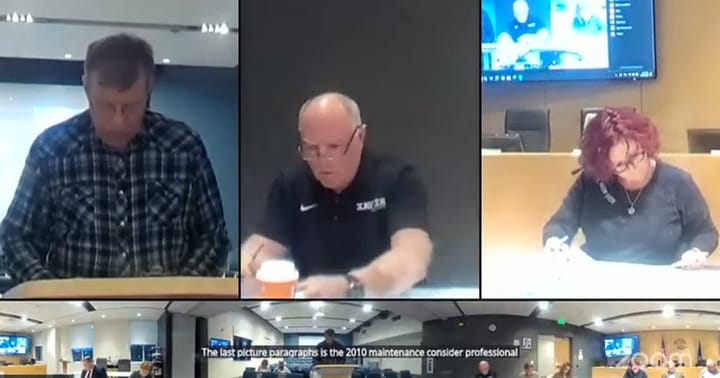
Town Council · Meeting of September 29, 2026
EAST HAMPTON — The East Hampton Town Council worked through a draft rewrite of the town's sewer oversight ordinance but took no vote on the substance, adopting only the meeting agenda by a 6-0 vote. Town Manager David Cox relayed Town Attorney Richard Carella's opinion that the Water Pollution Control Authority can buy land in its own name when purchases are funded entirely by utility revenue, a point members spent much of the meeting trying to work around without success. Council members agreed to shorten WPCA commissioner terms from five years to three and settled on a $25,000 threshold for council notice on professional-services contracts and litigation settlements, with $50,000 for major contracts and capital projects.
"I still don't think that it's legal... unless we have some legal opinion that says that we are allowed to limit what they can purchase with their own funds, I don't think that is possible," one member said. The council agreed it would review, but not formally approve, the WPCA's annual operating budget, and said a public hearing on the finished ordinance would follow further legal review by Carella.
In the full story:
- Who Was There
- Organizations And Documents Referenced
- The complete report — 2,031 words
Source: the Town Council meeting of September 29, 2026, reported from the official video recording and transcript.
The Full Article
Call to Order, Agenda and Public Remarks
Chairman Dean Markham called the special meeting and workshop to order at 6:32 p.m. in Town Hall Council Chambers and via Zoom, according to the meeting minutes. On a motion by Vice Chairman Jack Solomon, seconded by Council Member Joelyn Leon, the council adopted the agenda by a vote of 6-0. Council Member Richard Knotek was recorded absent.
Two residents spoke during public remarks, both addressing notice-period language in the draft ordinance rather than the land-acquisition and budget questions that dominated the later discussion. Leonard Johnson, of Long Crossing Road, told the council that Section 146-9's requirement that notice of significant matters be given "sufficiently in advance" of a final commission action should instead specify an exact number of days, suggesting "at least 15 calendar days," and recommended the ordinance clarify throughout whether notice periods are measured in calendar or business days. He raised the same concern about a provision requiring written notice of charges against a commissioner "not less than 10 days" before a removal hearing. Cindy Craig, of 3 Candlewood Drive, said she agreed with Johnson and reiterated a position she said she had made previously, that WPCA members should have relevant prior experience and not be trained "as they go," calling the authority's work "far too important" an endeavor for on-the-job learning.
Background and Stakes: WPCA Oversight Rewrite
The ordinance under review, Chapter 146 of the town code, created East Hampton's Water Pollution Control Authority in 1967 and has been amended several times, most recently in July 2024. Town Manager David Cox told the council the town attorney, Richard Carella, had produced a marked-up draft with commentary distinguishing between the council's financial oversight of the WPCA and the authority's day-to-day operational control, which state statute (Connecticut General Statutes Chapters 102 and 103) assigns largely to the WPCA itself once it is designated. Cox said the italicized material at the start of the posted draft reflected his own understanding, after a conversation with Carella, of where that line falls: the WPCA needs full operational authority, but the council can retain "a reasonable control of finance."
The question before the council Tuesday was not whether to adopt the ordinance, no vote on substantive language was scheduled, but how far to go in specifying dollar thresholds, notice periods, term lengths and land-acquisition procedures before sending a finished draft back to Carella for a legality check and, eventually, to a public hearing.
Property Acquisition Authority
The thorniest topic was whether the WPCA can buy land in its own name, separate from the town, and whether the council can limit that power. Cox reminded members that Carella's opinion from earlier in the year held that when an acquisition is funded entirely by utility revenue, the town's standard land-acquisition process, which otherwise runs through town meeting under the charter, is not the appropriate mechanism; a WPCA-funded purchase could instead be deeded directly to "the East Hampton WPCA" rather than to the town. One member noted this appeared to conflict with earlier draft language that routed land acquisitions through town meeting, and said Carella had agreed, on a follow-up call, that the distinction turns entirely on funding source.
Members worked through several options to preserve some council leverage without contradicting that opinion. One suggestion was to require the WPCA to notify the council of any pending land purchase regardless of size; another was to prohibit the town from bonding or maintaining any structure built on WPCA-owned land, on the theory that the WPCA would be reluctant to buy land it could not afford to develop with its own funds. "You can buy the car, but I'm not giving you gas money," one member said, describing that approach. Another member called the idea "a little backhanded" and said the council should aim for more direct language if possible. No resolution was reached; Cox said he would raise the land-acquisition question again with Carella and look at how comparable municipalities have split the authority.
The discussion also touched on the regional joint sewage-treatment facility the WPCA operates with the town of Colchester. Members noted the joint facility itself could potentially acquire land if both towns' WPCAs agreed, since the facility is a jointly controlled entity, though participants said they were not aware of the joint facility ever having purchased property.
Term Limits for WPCA Members
Carella suggested shortening WPCA commissioner terms from the current five years to three, members said, to give the council more frequent opportunities to review appointees. Longer terms are typically used to insulate a board from political pressure, one member explained, but a shorter cycle would let the council decline to reappoint a commissioner who is "not cutting the mustard" without going through a formal removal hearing. The group discussed staggering initial appointments at one, two and three years so the full seven-member commission eventually rotates on a three-year basis. Members also discussed a town code provision allowing appointees to continue serving after their term expires until a successor is named, a practice participants acknowledged "has happened in the past quite significantly," though one member said it appeared to happen less often recently because the council has gotten more timely about making appointments.
On a separate point raised during public comment, members debated whether the ordinance should say the council "must" or only "may" consider professional experience when appointing WPCA members, as current language states. Several members said requiring it outright risked excluding capable volunteers without formal credentials; no consensus was reached, though sentiment favored strengthening the language somewhere between "may" and "must."
Purchasing and Contract Thresholds
Referencing the town's general purchasing policy, under which department heads can approve purchases up to $5,000, three quotes are required up to $10,000, and sealed bidding applies above $20,000, members agreed professional services should be treated separately because they fall outside that structure already. After going back and forth between $15,000, $20,000 and $25,000 as a trigger for council notice on professional-services spending, the group settled on $25,000. "I would go with 25 for this one; that would make sense," one member said. For major contracts and single capital projects, the council agreed on a $50,000 threshold, after discussing that routine items such as pump replacements, often $20,000 to $23,000, should remain inside the WPCA's existing operating budget without requiring separate council notice. One member said a capital project "would typically be over a hundred thousand" dollars in practice, meaning the $50,000 figure functions as an early-warning threshold rather than a cap most projects would actually hit.
Budget Review Authority
Members clarified that the council would not formally "approve" the WPCA's proposed annual operating budget the way it must approve the authority's water-side budget under statute, but would instead have the right to "review and comment." One member asked whether the council should have authority to reject an operating budget that appeared significantly out of line; the consensus leaned toward review and comment rather than formal rejection power, with the ability to tell the WPCA to "go back to the drawing board" if something looked unusual. The Board of Finance would be permitted, but not required, to make a non-binding recommendation on WPCA budgets, mirroring how it currently handles additional appropriation requests elsewhere in town government. Members agreed to add language referencing "proposed operating budgets," plural, since the WPCA submits separate water and sewer budgets, with the water budget still subject to statutory council approval.
Litigation and Settlement Threshold
The council agreed to set a $25,000 threshold for council notice on any settlement or judgment requiring a payment or financial commitment from the utility, aligning the figure with the town's insurance deductible. Members clarified the draft should reference "utility" payments specifically, since claims against the WPCA would be paid from utility funds even though the town remains ultimately responsible as a backstop. "So this should say utility, because we're not talking about payments. That's what I was talking about," one member said during the exchange.
Notice Periods and Service-Area Expansion
Returning to the issues Leonard Johnson raised in public comment, the council agreed to standardize public-notice requirements at 10 business days in advance of final commission action, rather than the 15 calendar days originally proposed, for consistency across the ordinance's sections. Members flagged the notice period for member-removal hearings, currently "not less than 10 days," for the same calendar-versus-business-day clarification, though they did not resolve during the meeting which standard applies there. On what counts as a "material" expansion of the WPCA's geographic service area, members agreed to borrow definitional language from the town's existing sewer moratorium, under which connecting to an already-installed pipe does not count as an extension, but running new pipe does.
Adding New Municipal Customers
Members discussed whether adding a new municipal customer to the regional system, which currently serves East Hampton and Colchester with committed volume allocations at the jointly operated treatment facility, should require council notice. One member said any such decision should also weigh the town's Plan of Conservation and Development, since committing additional treatment capacity to another municipality could conflict with capacity the town may need for identified local priorities such as housing development. Another member explained that neither East Hampton nor Colchester is currently at its committed volume limit, and that any additional capacity needs would be pursued "strategically" through the joint facility rather than on an ad hoc basis. The group left open whether this topic belongs under the ordinance's existing powers section or under the notice-to-council section for significant matters, saying it needed further drafting.
Procedural Steps and Outcome
No vote was taken on the substantive ordinance revisions. Minutes record that "the Council members generally expressed agreement with the direction of the revised ordinance language, contingent on final legal review by the town attorney to confirm legality of the outlined provisions." After that legal review, the council said it would schedule a public hearing before any vote to approve the revised ordinance. No date for either the legal review's completion or the public hearing was set at the meeting.
Implications and What Is Next
The thresholds and definitions discussed Tuesday will shape how much financial visibility the council has into WPCA spending and land purchases once the ordinance is finalized, affecting how ratepayer-funded capital projects, contracts and settlements move through town government. Residents should watch for the scheduling of a public hearing, which the council said would follow Attorney Carella's final legal review of the draft language.
Dean Markham, Chairman, presided over the meeting. Jack Solomon, Vice Chairman, moved adoption of the agenda. Tim Feegel, Member, present. Ted Hintz, Jr., Member, present. Joelyn Leon, Member, seconded adoption of the agenda. Karen Wanat, Member, present. Richard Knotek, Member, absent. David Cox, Town Manager, led the review of proposed ordinance revisions. Leonard Johnson, resident of Long Crossing Road, spoke during public remarks on notice-period language. Cindy Craig, resident of 3 Candlewood Drive, spoke during public remarks on WPCA member qualifications.
Town of Colchester — co-owner and partner municipality in the regional joint sewage-treatment facility discussed throughout the land-acquisition and capacity sections of the meeting. Chapter 146 of the East Hampton Town Code (Water and Sewer Authority) — the ordinance under revision; cited repeatedly for existing provisions on membership, officers, removal and budgeting that the council proposed to amend. Connecticut General Statutes Chapters 102 and 103 — cited as the statutory source of WPCA authority and the basis for the operational-control versus financial-oversight distinction discussed by Town Manager Cox. Town Attorney Richard Carella's draft markup and legal opinions (including a prior opinion from March 2026 on funding-source-based land acquisition) — the working document driving the entire meeting's discussion. East Hampton's existing sewer moratorium language — cited as a model for defining what counts as a "material" expansion of geographic service area. Plan of Conservation and Development (POCD) — cited by a council member as a consideration for decisions about adding new municipal customers to the regional treatment system. Town of East Hampton general purchasing policy — cited for comparison in setting WPCA-specific dollar thresholds for professional services and major contracts.
Share this story
Know someone in East Hampton who follows town government? Share Townbrief East Hampton: they can sign up free.