Council Advances $39.55 Million School Budget on 6-1 Vote
East Hampton Town Council advanced a fourth Board of Education referendum after a 6-1 vote.
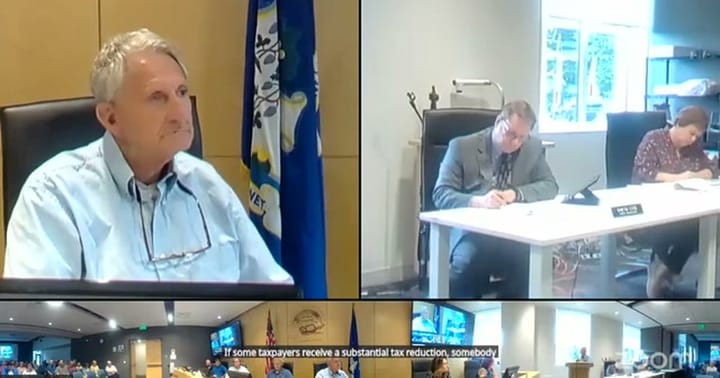
Town Council · Meeting of August 11, 2026
East Hampton Town Council advanced a fourth Board of Education referendum after a 6-1 vote. The council approved the $39,550,937 budget recommended by the Board of Finance, with Ted Hintz, Jr. as the sole "no" vote over how restored Smart Start and sports funding was handled; the referendum is set for August 26, with a town meeting August 19. Members also voted 7-0 to waive competitive bidding and award the Transfer Station's bulky waste contract to Belltown Recycling at $150 per ton, replacing All Waste and saving an estimated $30,000 annually.
A proposed homestead property tax exemption, which staff estimated could shift roughly $200 million onto the town's grand list burden, was shelved after Chairman Dean Markham said "that's off the table." The council took no action on a Middle Haddam land-sale inquiry, asking staff to return findings in September.
In the full story:
- Who Was There
- Organizations And Documents Referenced
- The complete report — 2,600 words
Source: the Town Council meeting of August 11, 2026, reported from the official video recording and transcript.
The Full Article
Call to Order, Minutes and Public Remarks
The council adopted its agenda and approved minutes from the July 21 special meeting and July 28 regular meeting without discussion, all by 7-0 votes. What followed was an unusually long public comment period, running roughly 40 minutes before the agenda's business items began and returning again near the meeting's end, reflecting the convergence of two charged topics: the fourth Board of Education budget referendum and a nascent proposal involving town-owned land near the former Middle Haddam School.
Speakers split largely along two lines. A cluster of residents, including East Hampton High School rising senior Jack Salafia and longtime teacher Becky Abbott, argued for passing the $39,550,937 Board of Education budget, warning that further cuts threaten Advanced Placement courses, arts programs and middle school sports. Salafia told the council, "Without these courses, students not only lose a vital portion of their education, but they are also less competitive in college admissions." Abbott, a 22-year district veteran, argued the town budget, not the schools, should cover maintenance of four large town-owned buildings used for community purposes. A second group, including Sal Nucifora and Bob Yenkner, pressed the Board of Education to find administrative savings rather than cut programs, with Yenkner noting the district employs roughly 203 staff for about 1,661 students while comparing that to 243 town employees serving roughly 12,900 residents.
A separate wave of speakers, including Anthony DeSimone, Lorena Walsh, Heather Garland, Jason Puglielli and Leslie Anderson Adams, focused on the Middle Haddam School property, several requesting that Council Member Ted Hintz, Jr. recuse himself from any vote on the matter, and several more asking the council to halt discussion until historic-district, zoning and environmental reviews occur.
Bids and Contracts: Bulky Waste Disposal
This item returned to the agenda after the council expressed intent at its July 28 meeting to waive competitive bidding; Connecticut law required publishing that intent before final action could be taken, which has now occurred. Director of Public Works Matthew Walsh's July 27 memo to Town Manager David Cox documented four quotes: Belltown Recycling at $150 per ton with hauling included; Casella (Willimantic Waste) at $127.04 per ton plus $250 per haul; and the incumbent, All Waste, at $156.50 per ton plus $170 per haul, for a combined average of $191 to $196 per ton. A supplemental, lower-priority quote from Eastern Transfer arrived after Walsh's memo was finalized.
The question before the council was whether to waive the formal RFP process, triggered because annual costs exceed the town's competitive-bidding threshold, and award the contract based on the four quotes already gathered. Hintz asked what the switch would actually save given the Transfer Station's planned reduced hours. Cox said the change would save in excess of $30,000 annualized and give the council flexibility in deciding the Transfer Station's future operating schedule. Solomon moved, seconded by Leon, to waive bidding and award the contract to Belltown Recycling; it passed 7-0.
New Business: September Temporary Education Budget
Because the fiscal year 2026-27 Board of Education budget has not cleared referendum, state law and the town charter require the council to adopt interim monthly budgets. The question was whether to approve a $3,191,165.56 one-month Board of Education budget for September, built from the figure most recently approved by the council and Board of Finance, including a $600,000 reduction. Hintz questioned whether the temporary budget assumed new hires not yet authorized by taxpayers, and what unemployment or termination costs the district might face if the final budget reverted to a lower, prior-year figure. Superintendent VanTasel said the district has vacancies held open for non-critical positions and will "calibrate month to month," as it did the previous year, to avoid ending the fiscal year in deficit. Leon moved, seconded by Wanat, to approve the temporary budget; it passed 7-0.
Board of Education Budget: Fourth Referendum
The Board of Finance recommended, for a second consecutive referendum, a Board of Education budget of $39,550,937 — unchanged from the amount voters rejected August 5. Hintz raised a procedural objection concerning Smart Start and middle school sports funding, both restored through outside grants and donations rather than added back to the expenditure line the Board of Finance sets. He argued that if the funding is now an added expense, however it's financed, the Board of Finance should have increased the expenditure figure to reflect it, and that the town charter bars the council from adding expenditures the Board of Finance has not authorized. A town finance official identified in the meeting only as "Jeff" explained the restored funding runs through a special revenue fund, similar to federal IDEA or Title grants, and does not change the general fund expenditure total. Hintz replied, "I believe that they have to increase that budget in order to make that legal," and said he would not support sending the budget forward on that procedural basis.
Wanat moved, seconded by Knotek, to approve the Fiscal Year 2026/2027 Board of Education budget of $39,550,937 as recommended by the Board of Finance. It passed 6-1, with Hintz the sole dissenting vote. The council then took up scheduling: Cox said the earliest possible referendum date under the 15-day notice requirement was August 26, with a town meeting the week before. Wanat moved, seconded by Leon, to set the town meeting for August 19 at 3:30 p.m. and the referendum for August 26 from 6 a.m. to 8 p.m., both at Town Hall; it passed 7-0.
Homestead Exemption Discussion
This item returned to the agenda after a Board of Finance member raised it again, though not as an official Board of Finance recommendation. Connecticut now allows two local-option homestead exemption structures: a 5 to 35 percent exemption of assessed value (Public Act 24-151, amended by Public Act 25-168) or, beginning with the October 1, 2027 grand list, a flat $50,000 exemption (Public Act 26-68). A property cannot receive both in the same year. The question before the council was whether to pursue further analysis, not whether to adopt an exemption.
Resident David Kahn warned in public comment that any exemption shifts tax burden onto renters, small businesses, owners of undeveloped land and motor-vehicle owners, none of whom benefit from the relief. Resident Steve Rickenbacher separately raised concern about a "cliff effect" under a percentage-based cap, where a single dollar of added value could cost a homeowner thousands in lost exemption. Council members said Jeff had run preliminary numbers on a hypothetical 22.5 percent exemption, estimating it would raise the town's grand list burden by roughly $200 million, push the mill rate up by a few dollars, and save exempted households about 10 to 11 percent on taxes. Hintz said he was "adamantly opposed," arguing homestead exemptions work better in high-tourism or heavily commercial towns, neither of which describes East Hampton. Cox noted only one Connecticut town, New Milford, has adopted a homestead exemption, and that the council did not request further data from staff. Markham summarized the consensus: "I join you all. So that's off the table." No vote was taken.
Land Matters: Middle Haddam School Parcel
The question arose after Middle Haddam Association representatives and their development partner met with Markham and Hintz to describe a concept converting the former school into six age- and income-restricted apartments plus 30 single-story townhouse units, likely structured under Connecticut's 8-30g affordable-housing statute. The project would need a town-owned half-acre parcel, formerly tennis courts, to proceed as conceived. No application has been filed with the Planning and Zoning Commission.
The question before the council was narrow: would it be willing to negotiate a sale of the town-owned parcel if the broader project were later approved through normal land-use channels. Attorney Brian Corvo, representing the association, said the request was limited to opening transparent negotiations, not seeking a sale outside the normal process: "There is no application right now because we don't fully own the parcel that we would need to develop." Residents Lorena Walsh and Heather Garland asked the council to pause until Historic District Commission, Planning and Zoning, and environmental review occur; Jason Puglielli cited Connecticut General Statute Section 8-24, which requires Planning and Zoning Commission referral before a municipality disposes of real property, and separately raised a potential conflict of interest involving the Historic District Commission's chair, whom he identified as also serving as a director of the Middle Haddam Association.
Cox clarified that any sale would require Planning and Zoning Commission and Board of Finance input and, ultimately, a town meeting vote, and that the council's decision was limited to whether to entertain negotiations at all. Members noted at least two prior inquiries to purchase the parcel, in 2018 and earlier, were declined because the land was understood to be designated open space; no documentation confirming that designation was produced Tuesday. Hintz and Leon asked whether the fire department might need the parcel for a firefighting water supply, an idea floated earlier in public comment by resident Douglas Mackeown, who proposed a 50,000-gallon tank given a history of house fires in the area with limited water access from the river. No motion was made. The council asked staff to research the parcel's history and relevant Plan of Conservation and Development language and report back in September.
Land Matters: Distefano Property and Other Inquiries
The owners of the Distefano property at Route 66 and Main Street proposed leasing it to the town for a park-like amenity in exchange for tax relief rather than lease payments. The town currently has no use for the parcel beyond informal signage. Several members, including Hintz, said they had no interest in removing a taxable, buildable commercial lot from the grand list through a lease arrangement; no formal proposal with dollar figures has been submitted. No action was taken.
Cox also disclosed a separate, unrelated inquiry about purchasing another town-owned parcel for agricultural use, and said his standard practice is to direct such inquiries to submit a letter to the council. Council Member Richard Knotek suggested the town consider identifying underused parcels that could be sold to seed a dedicated open-space acquisition fund, noting the town currently has only a small existing fund and no consistent process for such purchases. Members agreed the question would be revisited alongside the council's planned review of the draft Plan of Conservation and Development at next month's meeting.
Town Manager's Report, Appointments and Tax Refunds
Cox's written report, included with the agenda packet, addressed follow-up items from the July 28 meeting: he confirmed his own driveway and home are not plowed by Public Works despite a resident's question, and that Valli Estates sidewalks have been town-maintained under a 2010 ordinance predating his tenure. He also corrected a public estimate on affordable housing, stating the town has 215 qualifying units, about 3.8 percent of total housing, and would need roughly 349 more to reach the state's 10 percent threshold exempting it from certain forced-development provisions under Chapter 830g.
Knotek moved, seconded by Wanat, to appoint Teesha Grant to the Regional Agriculture Commission through December 31, 2029, filling East Hampton's previously vacant seat on the RiverCOG body; it passed 7-0. Feegel moved, seconded by Hintz, to approve $1,201.70 in tax refunds; it passed 7-0.
Second Public Remarks and Executive Session
Public comment resumed with Karen Johansmeyer suggesting the Middle Haddam schoolhouse could host the East Hampton 3rd Connecticut Regiment of Fifes and Drums, and Shelby Galvin publicly thanking parents and the state Office of Early Childhood for restoring Smart Start funding. Rebecca Harvey and resident Robert Baer raised concerns about unequal treatment of speakers during public comment, and attorney Brian Corvo returned to rebut what he characterized as prejudicial characterizations of the Middle Haddam proposal. Hintz responded to several comments, clarifying that Smart Start and sports funding was restored through one-time sources, not added to the ongoing budget, and noting he cast the lone "no" vote against bifurcating the town and education budgets years earlier out of concern it would divide the community.
Wanat moved, seconded by Knotek, to enter executive session for strategy and negotiation regarding collective bargaining, inviting Cox; the motion passed 7-0. The council returned and adjourned without further action, as required when exiting executive session.
Implications and What Is Next
The August 26 referendum will decide whether the $39.55 million education budget takes effect or the district faces a fifth round of cuts; a failed vote would also leave the Board of Education operating under a prior-year budget with an estimated $700,000-plus gap, raising questions about potential layoffs the council did not resolve Tuesday. The Middle Haddam parcel question and the broader town-owned-property inventory are expected to return in September alongside the draft Plan of Conservation and Development.
Dean Markham, Chair, presided over the meeting. Jack Solomon, Vice Chair, present and voting. Tim Feegel, Member, present and voting. Ted Hintz, Jr., Member, present and voting; cast the lone dissenting vote on the Board of Education budget. Richard Knotek, Member, present and voting. Joelyn Leon, Member, present and voting. Karen Wanat, Member, present and voting. David Cox, Town Manager, presented agenda items and the Town Manager's Report. Tim VanTasel, Superintendent of Schools, answered council questions on the temporary and fiscal-year Board of Education budgets. Matthew Walsh, Director of Public Works, prepared and presented the bulky waste hauling quotes. Cathy Sirois, Executive Assistant to the Town Council, recorded the minutes. A town finance official referred to only as "Jeff" answered budget-mechanics and homestead-exemption numerical questions. Brian Corvo, attorney for the Middle Haddam Association, spoke on behalf of the proposed Middle Haddam School property negotiation. Public commenters included Douglas Mackeown, David Kahn, Jack Salafia, Becky Abbott, Sal Nucifora, Matthew Puzzo, Bob Yenkner, Anthony DeSimone, Chris Bitel, Lorena Walsh, Heather Garland, Rebecca Harvey, Steve Rickenbacher, Jason Puglielli, Bryon Turner, Karen Johansmeyer, Shelby Galvin, Robert Baer, Leslie Anderson Adams and Valerie Baker, each identified in the minutes by name and address or affiliation.
Board of Finance — set the $39,550,937 Board of Education budget recommendation and the general government budget; its members' authority to set expenditures, which the council cannot increase, was central to the budget dispute. Middle Haddam Association, Inc. — nonprofit owner of the former Middle Haddam School, seeking to negotiate acquisition of an adjacent town-owned parcel for a housing project. Middle Haddam Preservation LLC / Vesta Corporation — development entity formed to pursue the Middle Haddam School project. Belltown Recycling (Fowler's Auto Wrecking Inc.) — awarded the bulky waste disposal contract at $150 per ton. Casella (Willimantic Waste Paper Co.) — submitted a competing bulky waste quote of $127.04 per ton plus $250 per haul. All Waste — incumbent Transfer Station hauler, charging roughly $191 to $196 per ton combined. RiverCOG Regional Agriculture Council — regional advisory body to which Teesha Grant was appointed as East Hampton's representative. Connecticut General Statute Section 8-24 — cited by resident Jason Puglielli as requiring Planning and Zoning Commission referral before any municipal land sale. Connecticut General Statute Section 7-147a (referenced in discussion as "7147-2") — cited regarding Historic District Commission certification-of-appropriateness requirements for the Middle Haddam parcel. Public Acts 24-151, 25-168 and 26-68 — the state laws establishing the two homestead exemption options the council reviewed and declined to pursue. Plan of Conservation and Development (draft) — cited repeatedly as the framework the council plans to use in September to evaluate town-owned parcels, including the Middle Haddam site. Office of Early Childhood — state agency credited by resident Shelby Galvin with helping restore Smart Start preschool program funding.
Share this story
Know someone in East Hampton who follows town government? Share Townbrief East Hampton: they can sign up free.