Council Approves $30,444 for LUCAS Device, Training
East Hampton Town Council approved $30,444.25 in opioid settlement funds for a mechanical CPR device and EMS training.
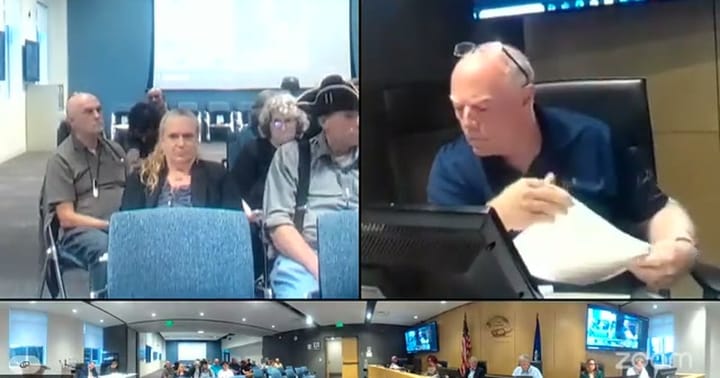
Town Council · Meeting of September 8, 2026
East Hampton Town Council approved $30,444.25 in opioid settlement funds for a mechanical CPR device and EMS training. The council voted 6-0 to give the East Hampton Ambulance Association $15,444.25 for a replacement Stryker LUCAS 3 device, after Chief of Service Chris Wherry said the group's oldest unit had failed and a second was at its eight-year service limit, plus $15,000 for additional training. Council Member Ted Hintz, Jr. was the lone dissenter in a separate 5-1 vote moving $593,400 in unanticipated revenue to the Capital Reserve Fund, saying "it should have gone to a town meeting." Consultant Juliet Hodge told the council East Hampton has lost 789 residents since 2000 while gaining over 1,000 households, calling it a "structural problem." The council also approved a Eversource utility easement for the Lakewood Estates subdivision and $4,020.50 in tax refunds, both 6-0.
In the full story:
- Who Was There
- Organizations And Documents Referenced
- The complete report — 2,657 words
Source: the Town Council meeting of September 8, 2026, reported from the official video recording and transcript.
The Full Article
Call to Order and Tabled Minutes
Chairman Dean Markham opened the meeting at 6:30 p.m. with six of seven members present; Council Member Tim Feegel was absent. The council adopted the night's agenda 6-0 on a motion by Karen Wanat, seconded by Joelyn Leon. Members then discussed revisions needed to the August 11 minutes concerning how much speaking time resident Becky Abbott had been given during two public-comment sessions that night, and voted 6-0 to table approval of those minutes until the clarifying language could be added. No vote was taken on the substance of the earlier meeting; this was purely a records-accuracy fix.
Public Remarks: Training, Reserves and Road Funding
East Hampton Fire Department Fire Chief Robert Rainville invited the council and town manager to live-burn training sessions scheduled for September 20 and September 24, and told members he endorsed the LUCAS device purchase slated for later in the agenda, saying "that piece of equipment saves us a lot of manpower."
Resident Rebecca Harvey, 39 Flanders Road, raised several budget-process concerns: she said the Route 66/Main Street property discussed later in the meeting had previously been set aside by the council, questioned why the town draws from the road budget rather than emergency reserves for projects such as the Wopowog Bridge, and asked the council to clarify how much the town holds in savings above its 12 percent reserve target and whether more could go toward road repairs. She also asked the council to extend the sewer moratorium an additional year to give a reorganized Water Pollution Control Authority board time to get up to speed, and asked whether the police chief had resigned, a rumor she said she had heard but could not confirm.
DiStefano Proposal for Route 66 and Main Street
Dan DiStefano presented a proposal on behalf of his family's property at the Route 66/Main Street gateway corner, which includes a small commercial building and an adjoining parcel. He described a possible 40-year lease arrangement under which the town would build a "town green" and historical memorial referencing East Hampton's industrial heritage — bell-making, shipbuilding and related trades — on the larger parcel (1 West High Street), with tax abatement on that parcel and on the adjacent rented building (7 West High Street) for as long as the land remains in the DiStefano family name. DiStefano said the town would assume liability and maintenance only for the town-green parcel, not the rented building, and that the arrangement would restrict political, commercial and most private signage, though community groups such as the VFW and Lions Club could continue posting notices. He offered historic granite foundation stones from the site's earlier building, known locally as Thatcher's, for potential use in the proposed green.
Council members pressed DiStefano on financial and zoning specifics. Combined property tax on the two parcels currently runs just under $5,700 annually, down from roughly $7,000 after a reassessment reduced the smaller building's valuation; abating that revenue for up to 40 years, plus insurance, was acknowledged by DiStefano as "a pretty hefty amount to pull off the tax rolls." Members also asked whether the land could instead be purchased outright, with DiStefano saying his father, who is 94, has received six lease offers on the building within the past year and that his siblings would likely prefer to sell outright rather than continue the lease arrangement.
"I don't want to see a metal building on that corner. I walk past that corner four or five nights a week with my wife and my dog," DiStefano said, explaining his preference for a town green over commercial redevelopment.
The council did not vote on the proposal and placed it on a future meeting agenda for further discussion.
Draft Plan of Conservation and Development
The Plan of Conservation and Development update exists because state law requires each municipality to revise its POCD roughly every ten years; East Hampton's current plan dates to 2016. Consultant Juliet Hodge, presenting for the POCD Steering Committee, told the council the draft plan is "99.9 percent" complete pending minor corrections and missing police and fire statistics. A similar presentation was given to the Planning and Zoning Commission on September 2, according to the town manager's memo accompanying the agenda.
The council was asked only to accept the presentation and schedule public comment, not to take substantive action. Hodge said the draft reorganizes the plan into three parts — an up-front section with goals, objectives and timelines; a data and evidence section; and a traditional, statute-required chapter-by-chapter section — a structure she said mirrors an approach increasingly used by other Connecticut towns, including Chaplin.
Hodge cited extensive public engagement: 663 survey respondents, 219 participants across focus groups, 113 at neighborhood meetings, 40 at a data-analysis session, 35 high school students, 62 at a visioning session and 20 on a village-center walk. She said residents' top priority was preserving rural character, open space and water quality, followed by concerns about taxes and the cost of living, and said nearly a quarter of survey respondents opposed any additional housing.
Hodge framed the town's core challenge as structural rather than a matter of governance: East Hampton has lost 789 residents since 2000 while gaining more than 1,000 households, driven by shrinking household size — 54 percent of households now have only one or two people — which pushes up the per-person cost of fixed municipal services even as school enrollment has fallen 20 percent. She said the town's median age, 43.1, is climbing, and that 81 percent of taxable value comes from single-family residential property against 7 percent from commercial and industrial uses combined, with a quarter of all town land untaxable.
"That's a significant structural problem that you need to solve," Hodge said.
The plan identifies seven goals, led by protecting natural resources, open space and water quality, and includes three modest housing-growth areas — near the Cobalt post office, in the existing industrial district, and around the village center and Hampton Woods — that Hodge said satisfy a state mandate requiring municipalities to designate areas for two-to-nine-unit "middle housing." She noted the only Department of Energy and Environmental Protection-approved sewer service area remains the map adopted in the 1970s.
No vote was taken. The council agreed to place the item on the September 22 agenda to open the formal public comment period, which will run through October with regional council-of-governments review, ahead of an expected Planning and Zoning Commission hearing in December and possible adoption by year's end.
Lakewood Estates Electrical Utility Easement
The council considered a resolution granting Eversource Energy an electrical distribution easement across land in the Lakewood Estates subdivision, including frontage that will become Freya Lane and land that will eventually be owned by the town as open space. Staff explained the request came after Planning and Zoning Commission approval of the subdivision because Eversource had not yet finalized how it wanted to route utility lines; the easement effectively moves the utility line roughly 20 feet from the roadway rather than running it beneath the road.
Council Member Hintz asked why the matter had not been resolved during the original Planning and Zoning review and whether it would have been approved under those circumstances; staff said they could only speculate but believed it likely would have been approved. Hintz also asked whether the easement would affect the adjoining 11-acre open-space parcel; staff said the easement crosses only the front ten feet of that parcel and does not disturb the balance of the open space.
A motion by Hintz, seconded by Jack Solomon, to authorize the town manager to sign the easement passed 6-0.
Capital Reserve Fund Appropriation
This item represents part of the fiscal year 2026 budget closeout. Town revenues exceeded estimates by $617,000, and the Board of Finance recommended transferring $593,400 of that unanticipated revenue — $175,000 in investment income, $178,400 in current taxes, $70,000 in delinquent tax interest, $70,000 in conveyance tax, and $100,000 in supplemental motor vehicle tax — into the Capital Reserve Fund to offset fiscal year 2027 capital projects. The Board of Finance approved the transfer 5-2 on August 17, 2026, with members Radavich and Walck dissenting, according to the town's appropriation request form.
The question before the council was narrow: whether to ratify the transfer of revenue the town manager said was not part of the unobligated reserve fund and therefore did not require town meeting approval, unlike a withdrawal from savings. Hintz pressed on this distinction, asking whether the funds exceeded the town's 12 percent reserve target; Cox confirmed the money was separate from that reserve.
"I just want to go on record again in saying that I think that it should have gone to a town meeting," Hintz said, adding that completing the transfer after year-end compounded his objection.
A motion by Solomon, seconded by Richard Knotek, to approve the appropriation passed 5-1, with Hintz dissenting.
Opioid Settlement Funds for LUCAS Device and EMS Training
The East Hampton Ambulance Association's letter, dated September 3 and signed by Chief of Service Chris Wherry, requested $15,444.25 from the town's roughly $110,000 opioid settlement account to buy a Stryker LUCAS 3, v3.1 mechanical chest-compression device. The quoted price was $19,204.20 list, reduced by a $4,000 trade-in credit for the failed unit and increased by $240.05 in shipping, per Stryker quote No. 11247064 dated August 27, 2026.
The question before the council was whether this qualified use of settlement funds, intended to address harms from the opioid crisis, extended to EMS equipment, and if so, how much. Wherry told the council EHAA operates three ambulances and normally equips each with one LUCAS device; the oldest, roughly 11 years old, failed mechanically, and the next-oldest, at eight years, has reached the manufacturer's recommended service life. He said fentanyl and other opioids can trigger respiratory depression leading to cardiac arrest, establishing the device's nexus to the settlement funds' purpose. The device performs chest compressions at a standard rate of 102 per minute with American Heart Association-compliant depth, he said, and frees responders to manage airways and medications simultaneously.
Council members questioned how often the device is actually used and whether training keeps pace. Wherry said he had personally used the device twice in the preceding five days but did not have full-year usage data on hand, and described a staged deployment process designed to minimize interruption to manual compressions, saying any delay from preparing the device is "a couple of seconds." Knotek asked whether EMS training funds might be a better use of settlement money; Wanat said she would support the device purchase only if matched with additional training dollars, noting East Hampton's call volume is lower than cities', making repeated training important for muscle memory.
"I would rather take four or five seconds to get it on than risk ineffective CPR when you're moving the patient," Wherry said, describing the device's value during ambulance transport specifically.
A motion by Knotek, seconded by Solomon, to allocate $15,444.25 for the device and an additional $15,000 for training, contingent on Wherry returning with a specific training plan and timeline, passed 6-0.
WPCA Ordinance Discussion
This discussion stems from the council's stated intent, following recent turnover on the Water Pollution Control Authority, to reshape how the town manages water and sewer governance. The question before the council was high-level: whether the council itself should continue to act as the WPCA for major decisions while a separate Water & Sewer Commission handles day-to-day operations, as outlined in Town Code Chapter 146.
Hintz circulated a proposal along these lines. Jack Solomon cautioned that formally re-creating a "water pollution control authority" under state statute could cede certain town rights and control under Connecticut General Statutes Chapter 103, and said the matter needs town attorney review before the council commits to specific language.
"That particular wording and creating that authority does, by state statute, give up some of our rights and control," Solomon said.
No vote was taken. Members agreed to submit written suggestions before the next meeting, with a possible special meeting to narrow down preferred changes before directing the town manager and legal counsel to draft a revised ordinance; no date was set for that special meeting.
Historic District Commission Appointments and Term-Limit Debate
The Middle Haddam Historic District Commission asked the council to swap two members' seats: moving full member Kara Pederson to an alternate position with a term ending December 31, 2029, and promoting alternate David Loranger to full membership with a term ending December 31, 2028. A motion by Knotek, seconded by Wanat, passed 6-0.
The appointment prompted a broader discussion of term limits, which the council does not currently impose. Knotek, discussing the Appointments Committee's informal practice, said long-serving members are generally allowed to complete their current terms, with the committee interviewing only those seeking reappointment after an extended tenure to discuss whether new volunteers should be sought instead. He said the council has avoided removing sitting members before their terms expire because the only historical precedent for doing so was viewed as politically motivated. Markham added that the committee's preference, when a new volunteer is available, is to appoint the newcomer rather than reappoint automatically.
Tax Refunds and Closing Public Remarks
The council approved $4,020.50 in tax refunds on a motion by Hintz, seconded by Wanat, 6-0. During closing public remarks, Fire Chief Rainville clarified that roughly 20 of the department's 76 members maintain medical certification requiring recurring training, with about 10 due for recertification this cycle, and that the department spends about $22,000 annually on training that could be supplemented by the newly allocated opioid training funds. A council member suggested the police department consider similar training given officers are often first on scene.
Dean Markham, Chairman, presiding. Jack Solomon, Vice Chairman, present. Ted Hintz, Jr., Member, present; cast the lone dissenting vote on the capital reserve appropriation. Richard Knotek, Member, present. Joelyn Leon, Member, present. Karen Wanat, Member, present. Tim Feegel, Member, absent. David Cox, Town Manager, present, answered questions on the capital reserve transfer and opioid fund balance. Cathy Sirois, Executive Assistant to the Town Council, prepared and submitted the meeting minutes as recording clerk. Robert Rainville, East Hampton Fire Department Fire Chief, public commenter and later provided training clarifications. Rebecca Harvey, resident of 39 Flanders Road, public commenter on reserves, roads and the sewer moratorium. Dan DiStefano, property owner's representative, presented the Route 66/Main Street proposal. Juliet Hodge, consultant to the POCD Steering Committee, presented the draft Plan of Conservation and Development. Chris Wherry, Chief of Service, East Hampton Ambulance Association, presented the LUCAS device request.
Eversource Energy (The Connecticut Light and Power Company) — utility granted the Lakewood Estates electrical distribution easement approved 6-0. Board of Finance — recommended the $593,400 capital reserve transfer, approved it 5-2 on August 17, 2026, per the town's appropriation request form. POCD Steering Committee — sponsoring body for the draft Plan of Conservation and Development presented by Juliet Hodge. Planning and Zoning Commission — received a similar POCD presentation September 2 and will hold the expected December adoption hearing; also reviewed the Lakewood Estates subdivision ahead of the easement request. East Hampton Ambulance Association — requested opioid settlement funds for the LUCAS device purchase. Stryker Medical — manufacturer supplying the LUCAS 3, v3.1 device under Quote No. 11247064, dated August 27, 2026. Middle Haddam Historic District Commission — requested the Pederson/Loranger appointment swap. Town Code Chapter 146 (Water and Sewer Authority) — existing ordinance governing the current Water Pollution Control Authority structure, cited in the WPCA discussion. Connecticut General Statutes Chapter 103 (Municipal Sewerage Systems) — cited by Solomon regarding statutory implications of designating a water pollution control authority. America 250 Committee — East Hampton float participated in the Middletown parade; committee requested a future presentation to the council.
Share this story
Know someone in East Hampton who follows town government? Share Townbrief East Hampton: they can sign up free.