Council waives bid rules for waste hauler
The East Hampton Town Council voted 7-0 to approve a $6,253,330 one-month August budget and waive competitive bidding for bulky waste hauling.
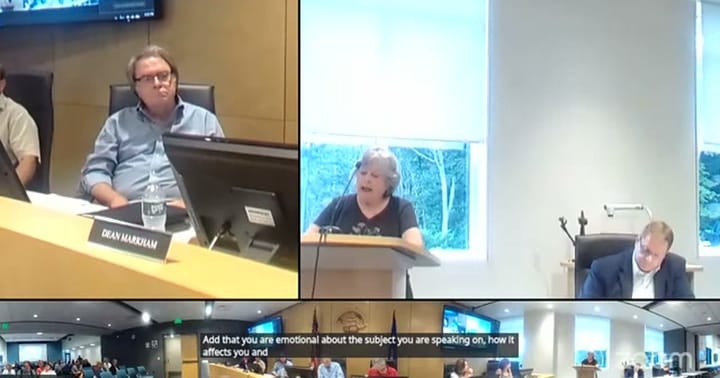
Town Council · Meeting of July 28, 2026
EAST HAMPTON — The East Hampton Town Council voted 7-0 to approve a $6,253,330 one-month August budget and waive competitive bidding for bulky waste hauling. Town Manager David Cox said the temporary budget was needed because voters have not yet approved the fiscal year 2026-2027 budget, up for an August 5 referendum. Public Works Director Matt Walsh said switching from All Waste to Belltown Recycling at $150 per ton, with no trucking fee, could save the town $20,000 to $42,000 annually.
Resident Valerie Baker objected, saying "if the bid submitted by our resident person is the best bid, then it should be able to stand up to scrutiny." The council took no vote on potential sidewalk snow removal cuts or the mandated January 1, 2027, transfer station closure, instead asking staff for more data before deciding.
In the full story:
- Who Was There
- Organizations And Documents Referenced
- The complete report — 2,672 words
Source: the Town Council meeting of July 28, 2026, reported from the official video recording and transcript.
The Full Article
Public Remarks: Development Fights, Veterans Access and Meeting Decorum
Public comment ran long and touched several threads that will likely resurface at future meetings even though none required council action Tuesday. The session opened with Cindy Craig, of 3 Candlewood Drive, asking that council members surrender phones to the administrative table before meetings begin, saying she had watched a member look at a phone during a prior speaker's remarks. Karen Johansmeyer, of Penny Corner Road in Portland and a member of the East Hampton 3rd Connecticut Regiment of Fifes and Drums, thanked the council for the late Mrs. O'Neill's support of the fife-and-drum tradition. Christopher Haagenson, of 110 Hog Hill Road, a retired Navy chief petty officer, asked the town to improve how staff handle veterans' benefits questions rather than "defaulting to denial."
The largest bloc of comment concerned a proposed Middle Haddam housing development discussed in connection with a potential sale of Middle Haddam School property. Resident Anthony DeSimone asked that Council Member Ted Hintz Jr. recuse himself from any future vote, citing Hintz's residence in Middle Haddam and online posts; DeSimone also defended routine developer meetings with town staff as standard practice rather than "backdoor deals." Resident Joe Hecht called a reported 36-unit apartment proposal on 2.7 acres with a septic system "fraudulent" and not legally feasible. Jason Puglielli, of Schoolhouse Lane, cited the property's R2 zoning and a neighbor's recently denied garage permit, and asked for environmental, traffic, wetlands and historic-district studies before any action. Rebecca Harvey and Rebecca Hodge both thanked Hintz for hosting a community meeting at the Middle Haddam Library the prior night and separately argued DeSimone's own public comments should be disregarded given his described conflict of interest. No vote or further council discussion on the development occurred at this meeting; it surfaced only in public remarks.
Resident Valerie Baker also used public comment to oppose both the bulky-waste bid waiver on the night's agenda and any further residential sewer expansion, referencing an unspecified Schoolhouse Lane development memo she said omitted septic infrastructure from renderings. Chris Bitel, of Old Clark Hill Road, asked the council to consider establishing a dedicated open-space acquisition program and specifically to look at purchasing the Hazen Tree Farm parcel, which he said was listed near $1.2 million, potentially financed with a 30-year note and the town's reported budget surplus.
Setting a Temporary Budget for August
Background and stakes: East Hampton's fiscal year 2026-2027 budget has not been finalized; the Board of Finance's proposed budget, now at its third referendum scheduled for August 5, totals $58,909,897. State law and the town charter require the council to adopt a temporary monthly budget to keep government operating in the interim.
The question before the body: whether to adopt Town Manager David Cox's recommended $6,253,330 spending authorization for August.
Substantive content: The packet breakdown shows $3,347,416 for education — covering certified and classified salaries, medical insurance and the start of the school year — and $2,905,914 for general town government, including $1,966,403 in debt service tied to a July principal payment of $1,680,000 and a July interest payment of $286,403. Town operations categories include $337,281 for administration and finance, $217,250 for public safety, $228,500 for public works, $84,800 for culture and recreation, $47,250 for regulatory functions and $24,430 for health and human services.
The deliberation: Cox explained that education figures rise and town figures fall slightly month to month depending on which payments have already cleared. Feegel asked whether the town had tracked how accurately July's temporary budget matched actual spending; Cox said he had not yet run that comparison. No member raised objections to the August figure itself.
Procedural steps and outcome: Knotek moved to approve the $6,253,330 monthly budget, seconded by Solomon. The motion carried 7-0 with no discussion of amendments.
Implications and what is next: This temporary budget becomes moot once voters approve a final fiscal year budget at referendum; the August 5 vote is the next relevant date for residents.
Bulky Waste Hauling: A Bid Waiver and a Cost Comparison
Background and stakes: The town has used hauler All Waste since a regional MIRA disposal contract expired roughly two years ago, without competitive bidding. Rising trucking fees from All Waste, combined with this year's budget-cutting exercise, prompted Public Works Director Matt Walsh to solicit comparison quotes.
The question before the body: whether to waive the town code's requirement for sealed competitive bidding on a contract Cox estimated at roughly $100,000, in favor of awarding the work based on quotes already received.
Substantive content: Walsh's July 27 memo to Cox lists three solicited quotes plus the current vendor's rates. All Waste charges $156.50 per ton for disposal plus $170 per trip for trucking. Belltown Recycling, a local facility on Old Coach Road, quoted a flat $150 per ton with hauling included and offered to lock that rate for the full fiscal year. Casella's Willimantic Waste Paper Co. quoted $127.04 per ton but $250 per trip in trucking, since its facility is farther away. Walsh told the council the town disposes of 665 to 775 tons of bulky waste annually, with each dumpster typically carrying four to seven tons, and estimated total savings versus All Waste at somewhere between $20,000 and $42,000 a year depending on tonnage mix. He said current effective costs run about $195 a ton.
The deliberation: Knotek asked whether the town was obligated to pay Belltown even if it stopped hauling materials under a one-year rate lock; Cox and Walsh said no such obligation exists, calling it a price guarantee rather than a binding contract. Wanat asked about the threshold for requiring a formal sealed bid and noted the town's $20,000 limit is lower than many comparable municipal thresholds. A member (unidentified on the recording) asked about access concerns on Old Coach Road; Walsh said that issue was separate from the hauling-rate question and tied instead to the broader transfer-station-closure discussion.
"It's just who's taking it away and how much. That's it. There's no change at the transfer station except for who's hauling dumpsters out of there, and the town of East Hampton is getting it at a cheaper rate than we're paying currently." [00:43:04] — Matt Walsh, Director of Public Works
Procedural steps and outcome: Hintz moved to waive the competitive bidding process in favor of the quotes obtained; Solomon seconded. The council approved 7-0. Cox said the waiver intent will be published for a week, with formal contract award possible at the August 11 meeting if no objections surface.
Implications and what is next: The council could award the roughly $100,000 contract to Belltown Recycling as early as August 11, lowering transfer station hauling costs regardless of what happens with the station's broader future.
Sidewalk Snow Removal: Liability, Equity and an Unanswered Mapping Request
Background and stakes: The Board of Finance's proposed budget eliminates overtime funding for sidewalk snow removal as part of roughly $690,949 in cumulative reductions approved across the second and third budget referenda. The cut, listed in budget documents as a $9,000 savings, would not eliminate the service outright but could delay weekend and after-hours plowing.
The question before the body: how the council wants to approach potential changes to town-provided sidewalk snow removal, and what information it needs before deciding anything.
Substantive content: Walsh told the council the town currently maintains about nine miles of sidewalk, while residents and property owners are responsible for an estimated 15 additional miles townwide. He said he could not document why some areas, including Valley Drive and portions near the Middle Haddam Fire District, are town-cleared while others are not, calling the arrangement "very convoluted."
The deliberation: One member said removing overtime funding without changing the underlying ordinance "raises so many problems," citing liability exposure if the town commits to clearing sidewalks but delays doing so after a storm. Another member noted the Board of Finance's adopted budget language specifically states the town will close service by certain dates, which the council itself never separately amended at the table. Wanat asked Walsh to identify specific trouble spots, particularly along Lake Pocotopaug, where plowed snow lands directly on narrow sidewalks or could be pushed into the lake, and around the town cemetery, where sidewalks are wide and heavily used by walkers.
"I have a major problem with the liability factor, taking out overtime and not doing sidewalks on the weekend, so I will not support something like that." [00:52:48] — unidentified council member
During public comment, Donna Benito, of 2A West Street, cited town code sections 273.10 and 273.11, which establish the town's sidewalk-clearing responsibility, and reported two accidents on her property last winter tied to narrow, unbuffered sidewalks. Rebecca Harvey argued residents should clear their own sidewalks and suggested a surcharge for those wanting continued service. Alexis Crean, of Lake Drive, supported keeping town service for Lake Drive residents, citing an older population and a wider-than-standard sidewalk.
Procedural steps and outcome: No motion was made. The council directed Walsh to prepare a map of town-maintained sidewalks identifying problem locations for members to review before any decision.
Implications and what is next: The council will revisit the issue once it has Walsh's sidewalk map; no date was set for that follow-up discussion.
Transfer Station Closure: The Belltown Proposal and Unresolved Questions
Background and stakes: The Board of Finance's third-referendum budget reduces the transfer station line item by $104,549 and specifies closure by January 1, 2027, to be replaced with private service, as part of the town's effort to close a roughly $690,949 cumulative budget gap. An unsolicited proposal from Belltown Recycling, forwarded to the council by Feegel, became the basis for that budget language.
The question before the body: whether and how to move toward closing town transfer station operations, and what alternative arrangement, if any, should replace it.
Substantive content: Cox described the Belltown proposal as covering most current transfer station materials — bulky waste, yard waste and brush, and metals — but not clearly addressing mattresses, electronics or cardboard. Under the concept, residents would pay Belltown directly per weighed load rather than through the town's current flat per-vehicle fee. Cox and Walsh said the core problem with current operations is that flat fees do not reflect actual disposal costs, particularly for heavy contractor loads such as roofing shingles carried in mason dump trucks, which can cost far more to dispose of than the fee charged. Walsh estimated roughly 750 households hold transfer station stickers. He said the facility's state disposal permit was recently renewed for another roughly seven-year term and members across the table said it should be preserved even if operations pause, to keep the option of reopening.
The deliberation: Knotek asked repeatedly whether the goal was to eliminate transfer station costs to the town entirely; Cox said that appeared to be the Board of Finance's intent. Wanat asked whether the town could restrict access to resident-stickered vehicles only, to exclude commercial contractors who she said drive up disposal costs by bringing heavy loads in oversized trailers while paying flat per-vehicle fees. Walsh agreed that distinguishing contractor loads from resident loads is operationally difficult because the town has no scale to weigh vehicles at the gate. One resident challenged a council member directly over the apparent conflict between the referendum language — which states the station will close January 1 — and the council's ongoing discussion of alternatives that could keep some town role.
"That is exactly what it says: that you're closing the dump on January 1." [01:25:06] — public comment
A member of the council responded that the council retains authority to make the final operational decision regardless of the referendum's budget language, prompting further audience pushback about public trust.
Procedural steps and outcome: No motion was made. Members agreed any formal transition — full closure with private service, third-party operation on the town site, or a regional arrangement with a neighboring town — should proceed through a request-for-proposals process rather than a direct award to Belltown.
Implications and what is next: The RFP process has not yet been scheduled or scoped. The January 1, 2027, closure date in the adopted Board of Finance budget remains in place unless the council or Board of Finance acts to change it.
Town Manager's Report, Appointments and Tax Refunds
Cox's written report, included in the packet, noted the Metafloc phosphorus treatment underway this week on Lake Pocotopaug to address algae growth, with no swimming restrictions. He also summarized the proposed fiscal year 2026-2027 budget ahead of the August 5 referendum: a 0.6 percent overall increase over last year, a 2.03 percent increase for education to $39,550,937, and a tax levy increase of about $47,748, or roughly a tenth of a percent.
The council made four appointments, each by motion from Knotek, seconded by Wanat, and approved 7-0: Chris Caldwell to a regular seat on the Agricultural Commission through December 31, 2028, cited for her experience developing a certified organic farm; Tyler Semrow to the Clean Energy Task Force through December 31, 2026; and a Fire Commission swap moving Darin Hurne from full member to alternate, and Dan Wasileweski from alternate to full member, with terms running through November 2027 and 2028 respectively.
The council also approved $1,131.08 in tax refunds across eight accounts, per a submission from Collector of Revenue Kristy Merrifield.
A second round of public comment grew contentious, with resident Billy Andermann calling the meeting "quite literally a clown show" over uncertainty about whether Board of Finance budget language supersedes council authority on the transfer station, and another commenter criticizing the lack of a full cost-comparison presentation before the waste-hauling discussion.
Chairman Dean Markham, presiding Vice Chairman Jack Solomon Member Tim Feegel Member Ted Hintz, Jr. Member Richard Knotek Member Joelyn Leon Member Karen Wanat Town Manager David Cox Director of Public Works Matt Walsh, presenting on transfer station and waste hauling items Cathy Sirois, Executive Assistant to the Town Council, recorded the minutes
Public commenters: Cindy Craig, 3 Candlewood Drive; Karen Johansmeyer, Penny Corner Road, Portland, member of the East Hampton 3rd Connecticut Regiment of Fifes and Drums; Christopher Haagenson, 110 Hog Hill Road; Valerie Baker, Lena Lane; Leonard Johnson, 21 Long Crossing Road; Thomas Crean, 35 Lake Drive; Anthony DeSimone, 26 Hog Hill Road; Joe Hecht, 265 White Birch Road; Chris Bitel, 15 Old Clark Hill Road; Rebecca Harvey, 39 Flanders Road; Jason Puglielli, 20 Schoolhouse Lane; Rebecca Hodge, Old Middletown Road, Cobalt; Alexis Crean, 35 Lake Drive; Donna Benito, 2A West Street; Rick Wanat, 35 Long Crossing; Billy Andermann, 37 Royal Oaks Avenue.
Outside parties cited but not present: Belltown Recycling Center (Fowler's Auto Wrecking Inc.), whose proposal drove the bulky-waste and transfer-station discussions, prepared by Operations Manager Joseph Warner; Casella/Willimantic Waste Paper Co., represented in bid documents by Municipal Account Manager Dan Zimmermann.
Belltown Recycling Center (Fowler's Auto Wrecking Inc.) — submitted the lowest bulky-waste quote and an unsolicited proposal to replace town transfer station operations entirely. Casella / Willimantic Waste Paper Co. — competing hauler quote at $127.04 per ton plus $250 per trip, cited for comparison. All Waste — the town's current hauler, used without competitive bid since a prior MIRA regional contract expired roughly two years ago. Board of Finance — authored the third-referendum fiscal year 2026-2027 budget, including the mandate to close the transfer station by January 1, 2027, and to eliminate sidewalk snow removal overtime funding. FY2026-2027 Board of Finance Proposed Budget (3rd Referendum), dated July 20, 2026 — the governing document for the August 5 referendum, cited throughout the budget and programmatic-change discussions. East Hampton Town Code Sections 273.10 and 273.11 — cited by resident Donna Benito as the ordinance basis for town-provided sidewalk snow removal; confirmed by the council to be amendable code, not charter. Town purchasing ordinance ($20,000 sealed-bid threshold) — cited by Town Manager Cox as the basis for requiring a bid waiver on the roughly $100,000 bulky-waste hauling contract.
Share this story
Know someone in East Hampton who follows town government? Share Townbrief East Hampton: they can sign up free.