Finance board cuts budget ahead of second vote
The Board of Finance voted 5-2 repeatedly to send a trimmed budget to a second referendum after the first vote failed.
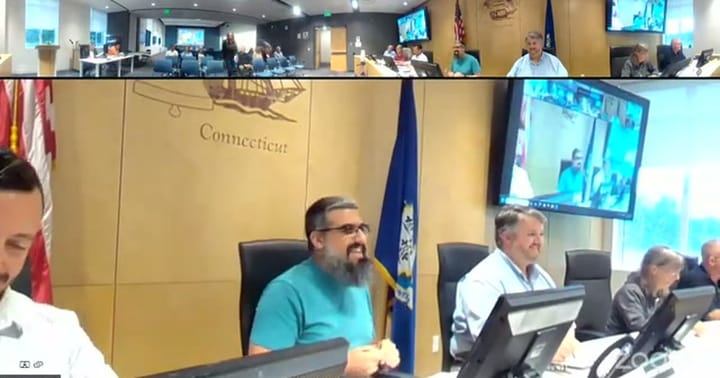
Board of Finance · Meeting of June 22, 2026
EAST HAMPTON — The Board of Finance voted 5-2 repeatedly to send a trimmed budget to a second referendum after the first vote failed. Chairman Anthony Spagnoletti led a board that rejected deeper cuts proposed by members Alison Walck and James Radavich, including eliminating a vacant police position and a $10 million road-bonding plan, before approving smaller reductions offered by Daniel Finn. The board set a $2,364,530 capital plan, a $19,699,909 town operations budget, and a $39,900,937 education budget, a $250,000 cut.
Police Chief Dennis Woessner warned that losing two more vacant officer positions would drop staffing "from 18 to 15," down to 13 after planned 2027 retirements. Town Manager David Cox said the town would rely on an anticipated $450,000 surplus to fund several one-time capital projects instead of borrowing. Transfer station hours will drop to two days a month under the approved plan.
In the full story:
- Who Was There
- Organizations And Documents Referenced
- The complete report — 2,169 words
Source: the Board of Finance meeting of June 22, 2026, reported from the official video recording and transcript.
The Full Article
Public Remarks: Preschool, Senior Center and Staffing Pressure
The June 22 special meeting opened, per the agenda, with the first of two public-remarks periods bracketing the board's budget work. This session exists because the town's first budget referendum failed, forcing the Board of Finance to revise capital, operations and education figures for a second vote.
Several speakers focused on preserving two specific line items: the Bellringer Preschool program and a full-time Senior Center staffing upgrade. Senior Center Director Holly Guerrero thanked the board for "not eliminating the full-time position request." Resident Haley Guite of 16 Curry Lane cited a petition signed by nearly 300 residents supporting early education and noted the town has more than 9,000 registered voters, "yet only a small percentage participated in the last referendum." Resident Neil Perrin, whose daughter graduated from East Hampton High School this year, said 10 students from this year's class who had been through the Bellringer program are pursuing education degrees, seven of them former Bellringer student-teachers themselves. Resident Cristal Chan of 34 Walnut Avenue argued for using fund balance on one-time capital needs rather than cutting services, saying "just because we reduce the budget doesn't mean that the needs of the town go away."
Dale Herrick of 74 Royal Oaks Avenue took the opposite tack, telling the board he had sent a detailed line-item analysis to the Board of Finance and Town Council identifying roughly $90,000 in potential town-side cuts, and argued the town could get its budget increase "down below" the 2.9 percent, $1.2 million increase neighboring Hebron had just passed. He also noted the state's fiscal 2027 budget added $383,000 for East Hampton.
Police Chief Dennis Woessner gave the most detailed public testimony, describing the department's staffing history: 15 officers in 2018, built up to 18 over several years, with two officers working alone on a shift 55 percent of the time in 2018 versus 48 percent by 2023 as staffing rose. He said the department has fielded 127 entry-level and nine certified applications since March 2024 but hired only three new officers, competing against 73 other Connecticut departments currently hiring. Richard Crabbe of 27 Skyline Drive urged the board toward revenue solutions over cuts: "No government in the history of governments has cut their way to prosperity." A caller identified as Shannon Turner of 42 Spice Hill Drive, participating by phone, cautioned against "shifting money around" rather than making real reductions, saying that approach does not address what voters asked for at referendum.
Capital Improvement Plan
Background and stakes: The capital plan had already been debated by the town's Capital Committee before this meeting; the question now was what to strip out after the first referendum failed, and whether to pursue a $10 million bonding package for roads within this budget cycle.
The question before the board: whether to recommend a capital improvement plan to Town Council that includes borrowing for roads, and if not, how to use available surplus instead.
Substantive content: Chairman Spagnoletti moved to approve a $12,164,530 capital plan consisting of a previously approved $2,439,530 base, modified by removing a $90,000 fire command vehicle, removing a $35,000 building department vehicle, deferring a $150,000 middle school air conditioning project, cutting $250,000 from road maintenance, increasing debt sinking by $250,000, and adding $10 million in bonding for a road reconstruction fund. James Radavich seconded. Finance Director Jeffery Jylkka clarified that the bonding piece would require a separate resolution process and would not, by itself, change the mill rate, since the removed items had been financed items rather than tax-levy items.
The deliberation: Spagnoletti questioned why the board would strip items that, by Jylkka's accounting, would not move the mill rate. "What is the thought process of these items being removed... since it's not really affecting the budget?" he asked. Finn argued the board needed a "more holistic plan" before committing to road bonding, saying building maintenance "is also very big and looming right there as well," and that bonding should be addressed after this budget cycle, not under referendum pressure. Public Works Director Matt, reached by phone during the meeting, estimated a $75,000 road-maintenance reduction would mean less chip-sealing work and some deferred paving, rather than a wholesale change to the paving schedule.
The original Walck/Radavich-backed motion failed 2-5, with Spagnoletti, Finn, Turner, Caterisano and Comisky opposed. Finn then moved a revised $2,364,530 plan: reallocating $28,000 from the Company 3 parking lot project back to the fire command vehicle line (cutting the amount to be financed from $90,000 to $62,000), funding five one-time projects — a $50,000 library/community center heating pipe replacement, $101,400 in school security items, $150,000 for middle school work, $47,000 for the Company 3 parking lot, and $105,000 for Hales Brook Crossing at Lake Drive — out of an anticipated $450,000 fiscal 2026 surplus rather than financing or cutting them, and reducing road maintenance by $75,000 instead of $250,000. Caterisano seconded. Fire Chief Robert Rainville, asked to justify the $90,000 vehicle cost, said an outside vendor quoted $140,000 for a comparable build, while a local vendor, Scranton Communications, donates installation labor, cutting the in-house build to roughly $60,000 to $62,000 plus equipment. One member asked whether the purchase should be postponed a year given the town's recent property reassessment; Rainville responded that the current 2011 Expedition has rust damage and recently lost its brakes en route to a call.
Procedural steps and outcome: The amended motion passed 5-2, Walck and Radavich opposed, setting a general fund transfer of $947,800 for the capital plan.
Implications and what is next: The board explicitly deferred a broader bonding discussion for roads and building maintenance to after this budget cycle, meaning no bonding question will appear on this referendum ballot.
Town Operations Budget
Background and stakes: With the capital plan settled, the board turned to the roughly $20.3 million town operations budget, where police staffing became the central dispute.
The question before the board: how much of the operations budget to cut, and specifically whether to eliminate currently vacant positions in the police department, Senior Center and Planning Department.
Substantive content: Walck moved to cut the $20,301,504 proposed budget to $20,101,504 by eliminating one vacant police officer position ($100,071), eliminating a proposed Senior Center part-time-to-full-time upgrade ($61,618), eliminating a proposed Planning Department part-time-to-full-time upgrade ($11,855), and reducing sidewalk snow-removal funding by $26,456. Radavich seconded.
The deliberation: Woessner argued that eliminating the vacant position would not actually save money because the town would still have to staff every shift, likely through overtime, which pays more than a filled position's salary. "If you cut here, you're going to pay for it here," he said, describing overtime at roughly $400,000 against a $220,000 budget line this year because of existing vacancies. He distinguished patrol overtime from a separate, revenue-generating arrangement in which outside contractors pay for off-duty officers to direct traffic under a town ordinance, which he said "doesn't cost the town anything" and in fact generates revenue. A board member pressed him on sick-time use; Woessner said he does not see a pattern of sick-time abuse and noted a state law bars him from requiring a reason for the first days of sick leave.
Procedural steps and outcome: The Walck motion failed 2-5, Spagnoletti, Finn, Turner, Caterisano and Comisky opposed. Town Manager David Cox then presented an alternative list of smaller reductions, described in his memo on file with the town clerk, including a half-position funding mechanism for the police vacancy rather than a full elimination. Finn moved a $19,699,909 budget reducing contingency by $10,000, eliminating a part-time Senior Center driver ($19,000), eliminating a Land Use/Building Department clerical position while funding a new assistant planner/land use enforcement role ($26,495 reduction), increasing the share of the Parks and Recreation program coordinator's salary charged to programs from 20 to 50 percent ($21,000), cutting transfer station operating days by two per month ($24,700), and reducing the capital reserve fund contribution by $500,400. Turner seconded. It passed 5-2, Walck and Radavich opposed.
Implications and what is next: The police department's authorized staffing level is unchanged under the approved budget, but the vacancy reduction debate did not resolve Woessner's overtime concerns. Transfer station hours will drop to two days a month unless Town Council raises transfer station fees to offset the cost, an option Cox said falls within council and board authority since it is under $25,000.
Education Budget
Background and stakes: State law and local practice limit the Board of Finance to setting a total dollar figure for the Board of Education; the finance board does not set which programs get cut.
The question before the board: what total figure to recommend for the Board of Education for the second referendum.
Substantive content and outcome: Radavich's initial motion was withdrawn after members identified a calculation error. Finn then moved to approve a $39,900,937 education budget, a $250,000 reduction, seconded by Comisky. It passed 5-2, Walck and Radavich opposed, with no further discussion recorded; members said the figure matched what had already been discussed the prior week.
The deliberation: Finn told the audience that the finance board "can only provide the Board of Education with a budget number," and it is up to the Board of Education which programs absorb the reduction. He urged residents who support programs like Bellringer and Smart Start to encourage friends and neighbors to vote, citing historical turnout of 25 to 30 percent.
Implications and what is next: The Board of Education will now decide internally how to apply the $250,000 reduction across programs, including whether Bellringer Preschool or Smart Start funding is affected, a decision not made by the finance board.
Second Public Comment and Adjournment
Resident Tom Seguin of 47 Cone Road asked whether capital-budget dollars tied to school facilities, such as $115,000 for Center School projects, were separate from the education operating budget, questioning whether the $250,000 cut represented a real reduction in services.
"So where is the Board of Education budget actually being reduced?" — Tom Seguin, resident, 47 Cone Road
Cox responded that capital funding and the $250,000 operating cut are "two separate pieces of discussion." Herrick countered that, combined with the night's other cuts, the town's overall budget increase would likely fall below the percentage Hebron just passed. Fire Chief Rainville and resident Neil Perrin closed public comment urging the board not to undervalue volunteer fire and police services, with Perrin noting only two patrol officers were on duty during a recent lockdown at the middle school. The board then adjourned at 9:26 p.m. on a motion by Finn, seconded by Walck, approved 7-0.
WHO WAS THERE
Anthony Spagnoletti, Chairman, present Daniel Finn, member, present David Caterisano, member, present Kurt Comisky, member, present James Radavich, member, present Ted Turner, member, present Alison Walck, member, present Jeffery Jylkka, Director of Finance, staff, present David Cox, Town Manager, staff, present Matt, Public Works Director, participated by phone (surname not given in available sources) Dennis Woessner, East Hampton Police Chief, public comment and Q&A Robert Rainville, East Hampton Volunteer Fire Department Fire Chief, public comment and Q&A Holly Guerrero, Senior Center Director, public comment Haley Guite, resident, 16 Curry Lane, public comment Neil Perrin, resident, 167 Injun Hollow Road, Haddam Neck, public comment Cristal Chan, resident, 34 Walnut Avenue, public comment Dale Herrick, resident, 74 Royal Oaks Avenue, public comment Richard Crabbe, resident, 27 Skyline Drive, public comment Shannon Turner, resident, 42 Spice Hill Drive, public comment by phone Tom Seguin, resident, 47 Cone Road, public comment
ORGANIZATIONS AND DOCUMENTS REFERENCED
Town Council — recommendation destination for all three budget items voted on; also holds separate authority over any future bonding resolution. Board of Education — body that will allocate the approved $39,900,937 total among individual programs, including Bellringer Preschool and Smart Start. East Hampton Capital Committee — cited by members as having previously, on a bipartisan basis, developed the road and vehicle capital plan being modified. East Hampton Volunteer Fire Department — Chief Rainville's testimony on fire command vehicle costs and firehouse repair needs (cited $22 million estimate to fix firehouses). East Hampton Police Department — Chief Woessner's staffing and overtime testimony drove the town operations debate. Scranton Communications — local vendor cited by Rainville as donating labor to reduce the in-house fire vehicle build cost. Town of Hebron — comparison town cited by Herrick for its 2.9 percent, $1.2 million budget increase passed on a third referendum attempt. River East — local newspaper cited by Herrick regarding a reader comment on Hebron's budget. Robert's Rules of Order — cited by Jylkka during procedural discussion of how to amend the capital motion on the floor. Hoopla — library e-book lending service referenced as a possible service-reduction target (cutting monthly checkouts from five to three). Extra Mile — public transit service referenced as a supplement if the Senior Center's second driver position is eliminated. State of Connecticut FY27 budget — cited by Herrick as adding $383,000 to East Hampton's revenue.
Share this story
Know someone in East Hampton who follows town government? Share Townbrief East Hampton: they can sign up free.